
It was expected to be a friendly Bill for the IT outsourcing industry
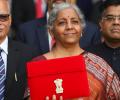
Had Finance Minister Sitharaman thought a little more about the middle class, disadvantaged sections, and the poor who are struggling, it would have been an inclusive Budget that would have made history, notes Ramesh Menon.
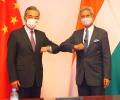
'We've never really been in the situation of having a difficult time with the Chinese and an increasingly difficult time with the Russians along with a relationship with the Americans which is important.'

Indian elections are won and lost on 'negative' imageries and campaigns - but not certainly on 'negativity' as a political trait and electoral creed, asserts N Sathiya Moorthy.

'I could see it not having any impact whatsoever,' says Stephen P Cohen on Obama's India visit.

England on Thursday suffered an embarrassing 10-wicket defeat in the third Test against India on a spin-friendly Motera track to go down 1-2 in the four-match series and the result garnered varied reactions from the British media.


Just 5 departments account for about 88 per cent of the Union government's civilian employees. A leaner bureaucracy will help Modi keep his promise of maximum governance with minimum government, says A K Bhattacharya.

'We used to say two things are found everywhere: A potato and a Sikh. I think you can substitute Gujarati for the Sikh because Gujaratis are everywhere.'

West Bengal Chief Minister Mamata Banerjee on Monday wrote to Prime Minister Narendra Modi, requesting him to withdraw the Centre's order recalling Chief Secretary Alapan Bandyopadhyay, and said her government 'is not releasing' the top bureaucrat.
Calling for "autonomy from red tape and local politics" in India, Nobel Laureate Indian-American scientist Venkataraman Ramakrishnan on Tuesday said many scientists of Indian origin may return home if the government made "attractive offers" to undertake research in science.
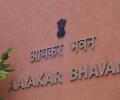
Sources said the action was in line with Prime Minister Narendra Modi's address to the nation from the ramparts of Red Fort when he said some black sheep in the tax administration may have misused their powers and harassed taxpayers, either by targeting honest assesses or by taking excessive action for minor or procedural violations.

'We first need to acknowledge the truth.' 'We are trying to diminish the problem and say, everything is okay and green shoots are emerging.' 'Imagine you are a doctor and not getting accurate medical reports, how do you diagnose and treat the illness?' 'We are not dealing with a terminal illness here, we are dealing with BP and cholesterol, which are imminently curable.'

While being "cautiously optimistic" about the country's economic growth, they said corruption and bureaucracy are among the 'big concerns' of the industry.
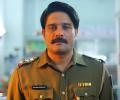
If Irrfan could have been our finest professor of empirical philosophy, and Nawaz is our foremost poet of that space halfway between the gutter and the stars, then Jaideep Ahlawat has to be our greatest artist-scientist, asserts Sreehari Nair.

"We are in an early stage of a long-run bull market," says Rakesh Jhunjhunwala.
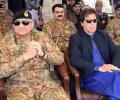
'Any conventional conflict could trigger a nuclear war with results that neither India nor Pakistan could survive easily.' >A revealing excerpt from Shuja Nawaz's The Battle For Pakistan: The Bitter US Friendship And A Tough Neighbourhood.

'If the Biden-Harris team makes it to the White House, India's headaches will multiply,' observes Aditi Phadnis.
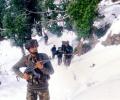
The army of the future needs a system of transparency and research. An open sociology of the army is a democratic necessity. An openness of information is a necessity of the army of the future fighting the next peace and next war on behalf of society, says social scientist Shiv Visvanathan.

In all this, the political establishment -- and especially the finance ministry -- appears the weakest link, and worse still, the possible reason for the political backing to Narain and Ramkrishna that emboldened them to defy all the sentinels -- the independent board, the auditors, top management persons like the chief compliance officer, the company secretary, and unbelievably the super-regulator Sebi, observes V Ranganathan.

After years of disappointing growth, the economy and the markets are poised for a breakout, notes Akash Prakash.
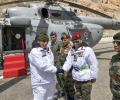
The defence minister has to correct a major asymmetry. Will his discipline come in the way?
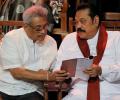
Gota has to decide if he could order elder brother Mahinda's arrest as the agent provocateur of Monday's violence. Then he has to prepare for an interim government, in which no one would now want to become a cabinet minister leave alone prime minister, explains N Sathiya Moorthy.
The anti-talks faction of the proscribed United Liberation Front of Assam on Friday criticised former Union Home Secretary G K Pillai for the comments he had made in a seminar in Guwahati a few days back and stated that the bigwigs in the bureaucracy in the 'colonial' Indian government should better do away with the habit of belittling the ULFA, the people of Assam and their 'revolution'.

>I would like to applaud Director Aarti Kadav for attempting a futuristic movie, but Cargo gets mired by a script which has been jammed with too many concepts, notes Moumita Bhattacharjee.

'Whether it will create an impact or not, only time will tell.'
The first step for the government to get out of this mess is to convince the public that they have taken note of its anger and are serious about dealing with this issue, suggests B raman

'If they succeed in silencing this great university, it will be a tragic day for the nation.'

Nilekani has kept pace with technology advances, has been instrumental in digitalising the country, and is well-networked with the bureaucracy and global leaders

'Civilian casualties are something that could change the mood overnight, and therefore should be avoided by every means.'

His father spent Rs 5 lakh on his studies. He works with a chartered accountant in Delhi for Rs 8,000 a month. He's excited at the thought of landing a job at Rs 17,000 -- even if it is as a sweeper.

'If the RBI had done the right things, these mistakes would not have happened in banks, public or private,' says Ajay Shah.

'It was Parrikar's sharp insights into finance and international systems that stood out when India --at his suggestion -- decided to procure the Rafale combat jets from France.'

In a path-breaking verdict, the Supreme Court on Thursday said bureaucrats should not act on verbal orders given by political bosses as it sought an end to frequent transfers and suggested a fixed tenure to insulate them from political interference.

The incident took place on Monday night in the presence of Kejriwal, a senior official alleged.

By asking that braces and struts be provided from all sides, will the Supreme Court be able to buttress the civil service spine so that it stands straight instead of bending over backwards, forward and sideways? Somehow, I doubt it.

'But India needs to remember Dr Roy, the multifaceted genius who excelled as a physician and was most loved as a leader,' notes Dr Sudhir Bisht.
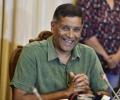
Rumours in the bureaucracy on his successor include the names of Sajjid Chinoy of JP Morgan, Rathin Roy of the National Institute of Public Finance and Policy, Neelkanth Mishra of Credit Suisse and the principal economic advisor, Sanjeev Sanyal.
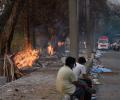
Shortage of ICU beds, oxygen, ventilators, vaccines, doctors, nurses and crematorium space in India has dominated headlines around the world in the past few weeks with Covid-19 cases surging beyond control and the government failing to deliver. Yes, election rallies, Kumbh Mela, blatant flouting of social distancing and mask protocols coupled with a messy vaccination process are said to be responsible for the health crisis of colossal proportions that India is facing today. But an analysis of Budget speeches made by finance ministers over 75 years also offers a glimpse of how low on the priority list healthcare has featured for the political class and policy-makers, which is a significant reason for the current situation.

If India wants to become a globally competitive manufacturing hub, it will have to rethink the notion that the traditional SMEs will form the manufacturing backbone, argues Prosenjit Datta.
